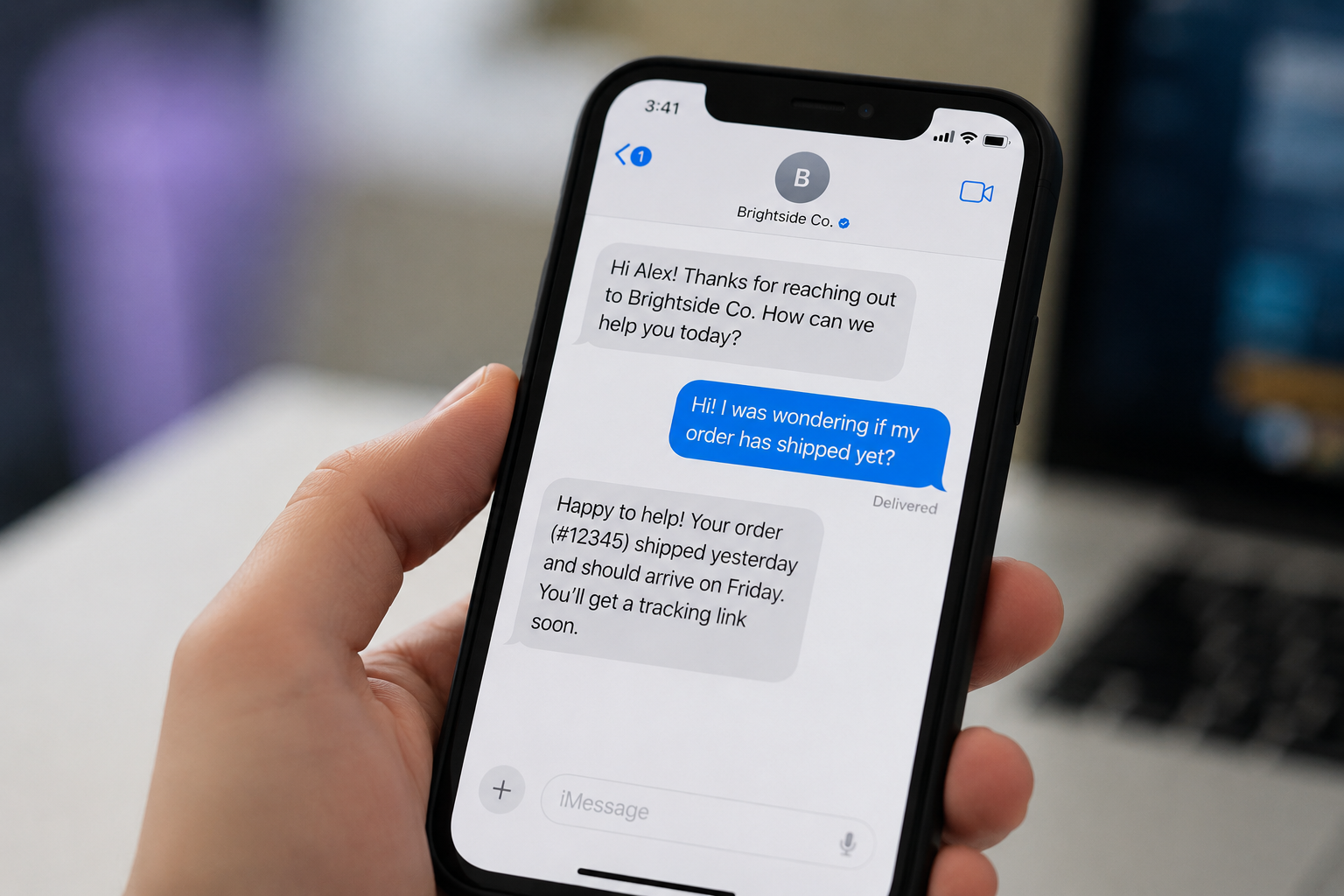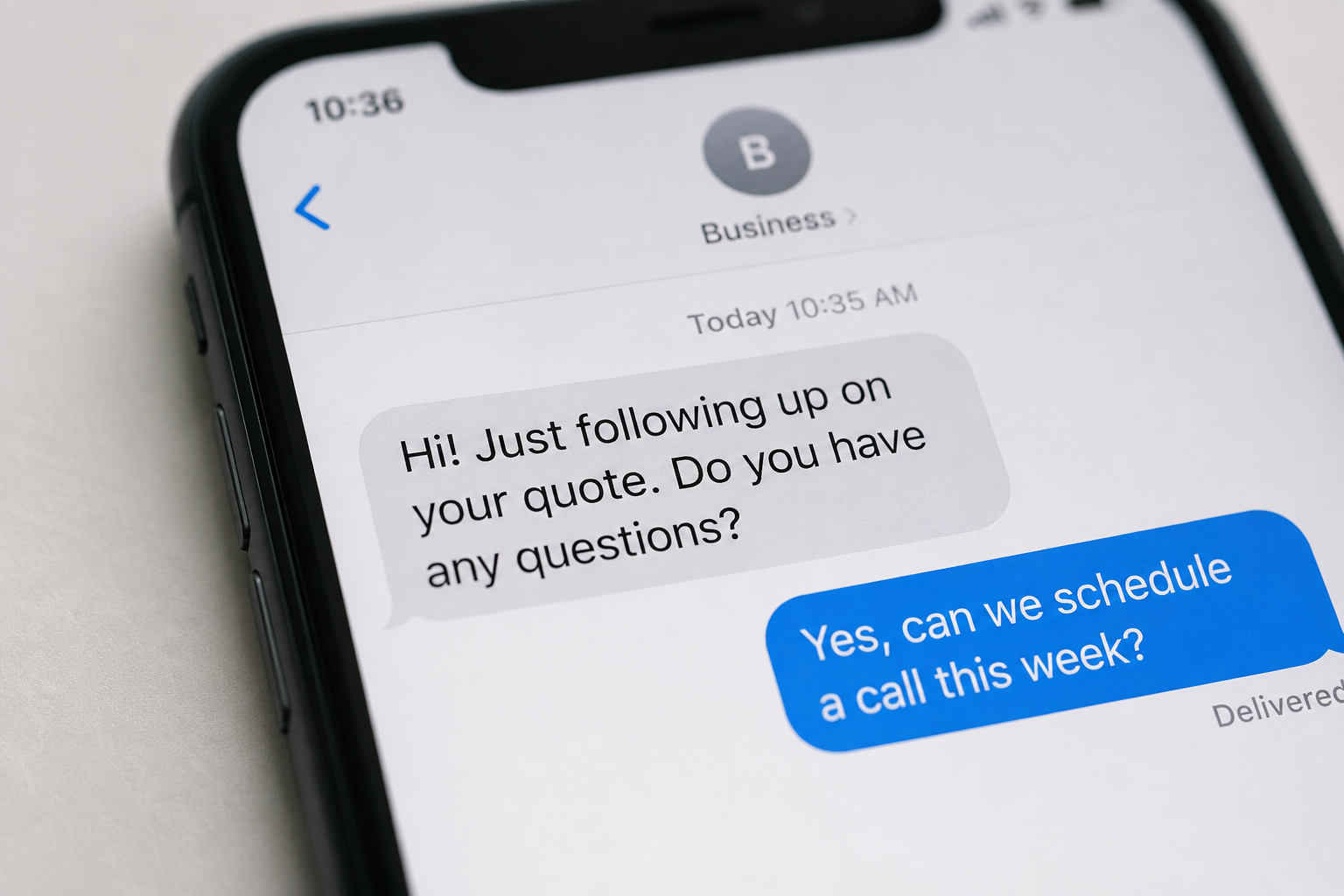
If your business runs lots of conversations with customers over text or chat, you probably don't know what's actually being said across all those threads once they're sent. Are customers happy? Are refund requests climbing? Is a new offer landing or falling flat? Usually the only way to find out is to have someone read through the conversations by hand, and that stops working the moment you have more than a few a day. It's the same blind spot we wrote about in the rise of AI-powered customer messaging.
Bloobability solves this. It's Blooio's customer conversation intelligence model: you tell it in plain language what you want to track, and it reads every conversation for you, keeping count of how often those things come up over time. Instead of guessing what your customers are saying, you get a real trend line — closer to sentiment analysis tuned to your exact business than to a generic dashboard. Want the deep version first? Read the plain-English non-technical explainer or the full model card.
What Bloobability Actually Does
Bloobability needs just two things from you: your conversations and a list of what you want to track. Each item is a short description in plain English — like "the customer asks for a refund" or "the customer sounds frustrated." You choose what matters for your business, not someone else.
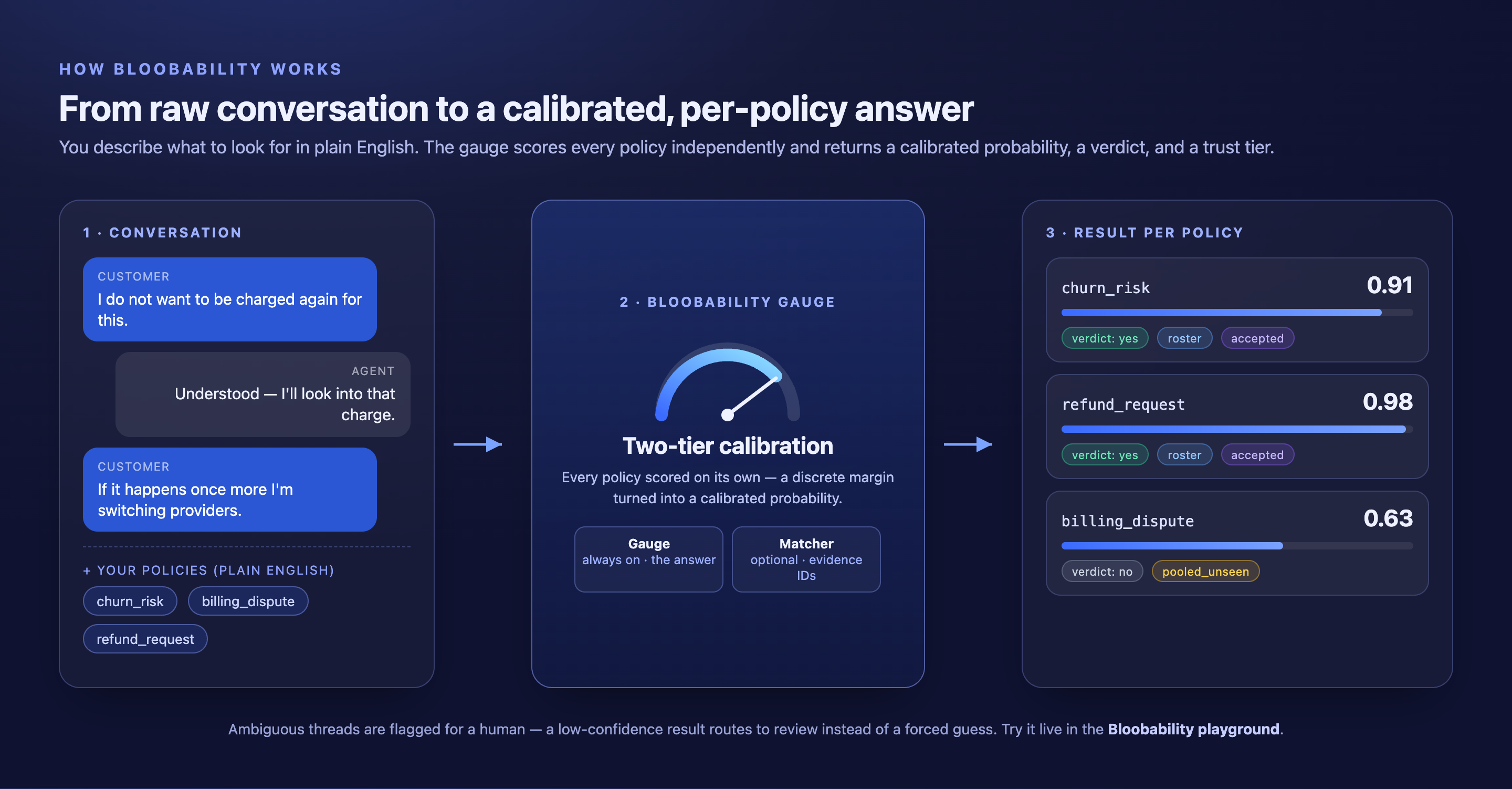
For each conversation, Bloobability checks your list and returns a simple yes or no for every item, along with a calibrated probability — a number between 0 and 1 that reflects how confident it is (the same idea as calibrated probabilistic classification). Over weeks or months you can see real trends: how often refund requests come up compared to last month, whether a new SMS campaign changed customer responses, or if one script gets more pushback than another. That's the kind of insight that lets you adjust your marketing or texting based on real conversations, not just click-through rates or reply counts.
- Track what you care about — churn signals, billing disputes, buying intent, frustration, script pushback.
- Get a verdict per thread — a yes/no call plus a calibrated probability, not a black-box guess.
- Know how far to trust it — every result carries a tier (
rostervspooled_unseen) and, for roster policies, a strictacceptedflag. - Watch the trend, not the noise — counts roll up over time so you see direction, not one-off anecdotes.
Try It Yourself — No Code
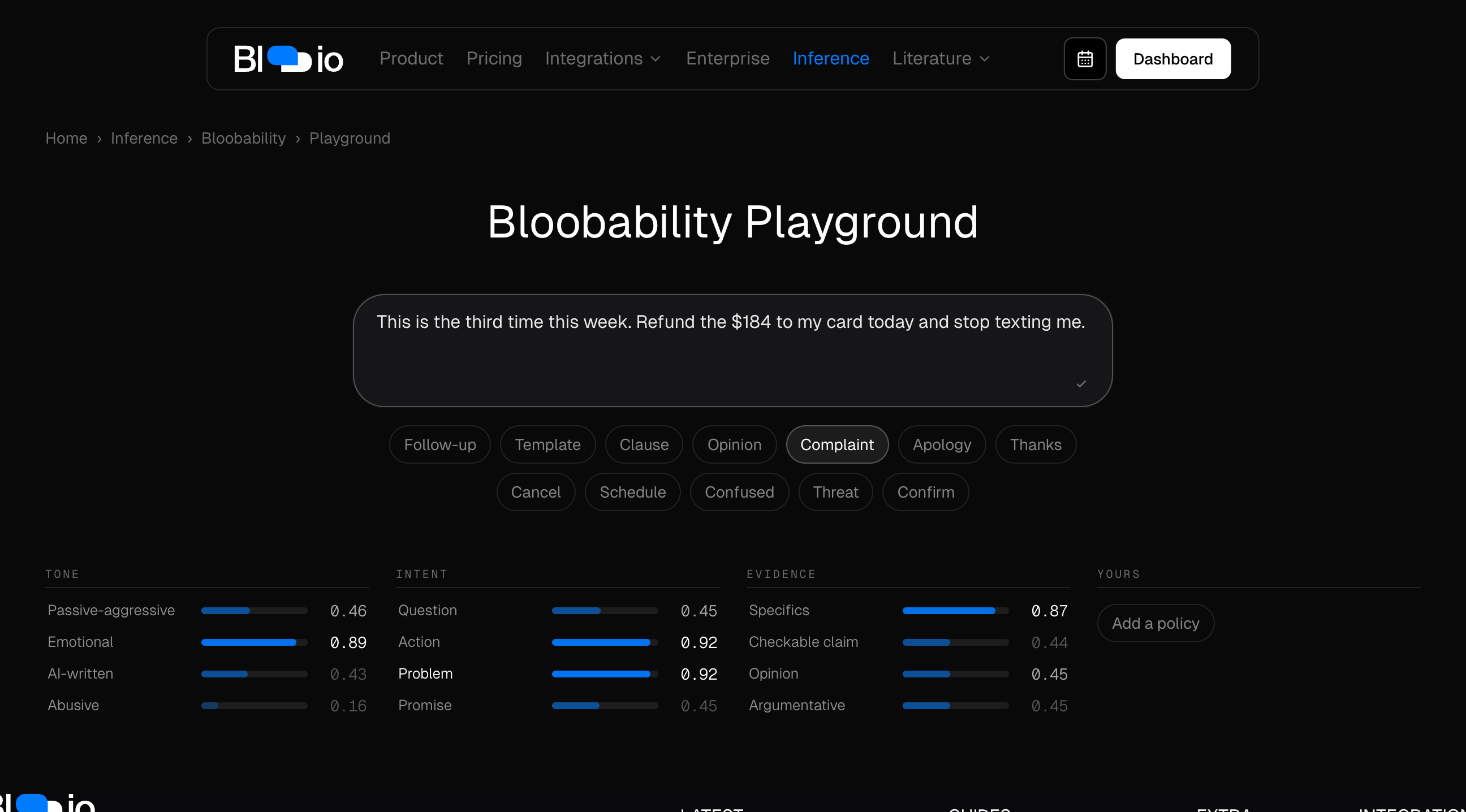
The fastest way to understand Bloobability is to watch it score a message live. Open the Bloobability playground, paste in a customer message (or pick a preset like "Complaint" or "Cancel"), and every built-in policy fills in with a score in real time — grouped into tone, intent, and evidence. You can even add your own policy in a sentence and watch it score alongside the built-ins.
A Request, Walked Through
Under the hood, Bloobability is a single API call: POST /ai/bloobability/assess. Say you want to catch customers who are threatening to leave. You send the conversation (each message carries an id, a role, and its content), a couple of policies described in plain English, and — if you want the model to point at the exact message that triggered a match — include_evidence: true.
POST https://api.blooio.com/v4/ai/bloobability/assess

{
  "reference_id": "ticket-8821",
  "conversation": [
    { "id": "m1", "role": "customer", "content": "I do not want to be charged again for this." },
    { "id": "m2", "role": "agent",    "content": "Understood — I'll look into that charge." },
    { "id": "m3", "role": "customer", "content": "If it happens one more time I'm switching providers." }
  ],
  "policies": [
    { "id": "churn_risk",      "description": "the customer says they want to cancel or switch providers" },
    { "id": "billing_dispute", "description": "the customer disputes a charge" }
  ],
  "include_evidence": true
}
Notice that neither description uses the word "cancel" — and Bloobability doesn't need it. It reads intent, not keywords. You get one result per policy, in the same order you sent them: a calibrated_probability, a verdict of yes or no, a calibration_tier, and — because you asked for evidence — the exact evidence_ids that support each match.
{
  "reference_id": "ticket-8821",
  "policies": [
    {
      "id": "churn_risk",
      "calibrated_probability": 0.91,
      "verdict": "yes",
      "calibration_tier": "pooled_unseen",
      "evidence_ids": ["m3"]
    },
    {
      "id": "billing_dispute",
      "calibrated_probability": 0.63,
      "verdict": "no",
      "calibration_tier": "pooled_unseen"
    }
  ]
}Call It From Your Own Stack
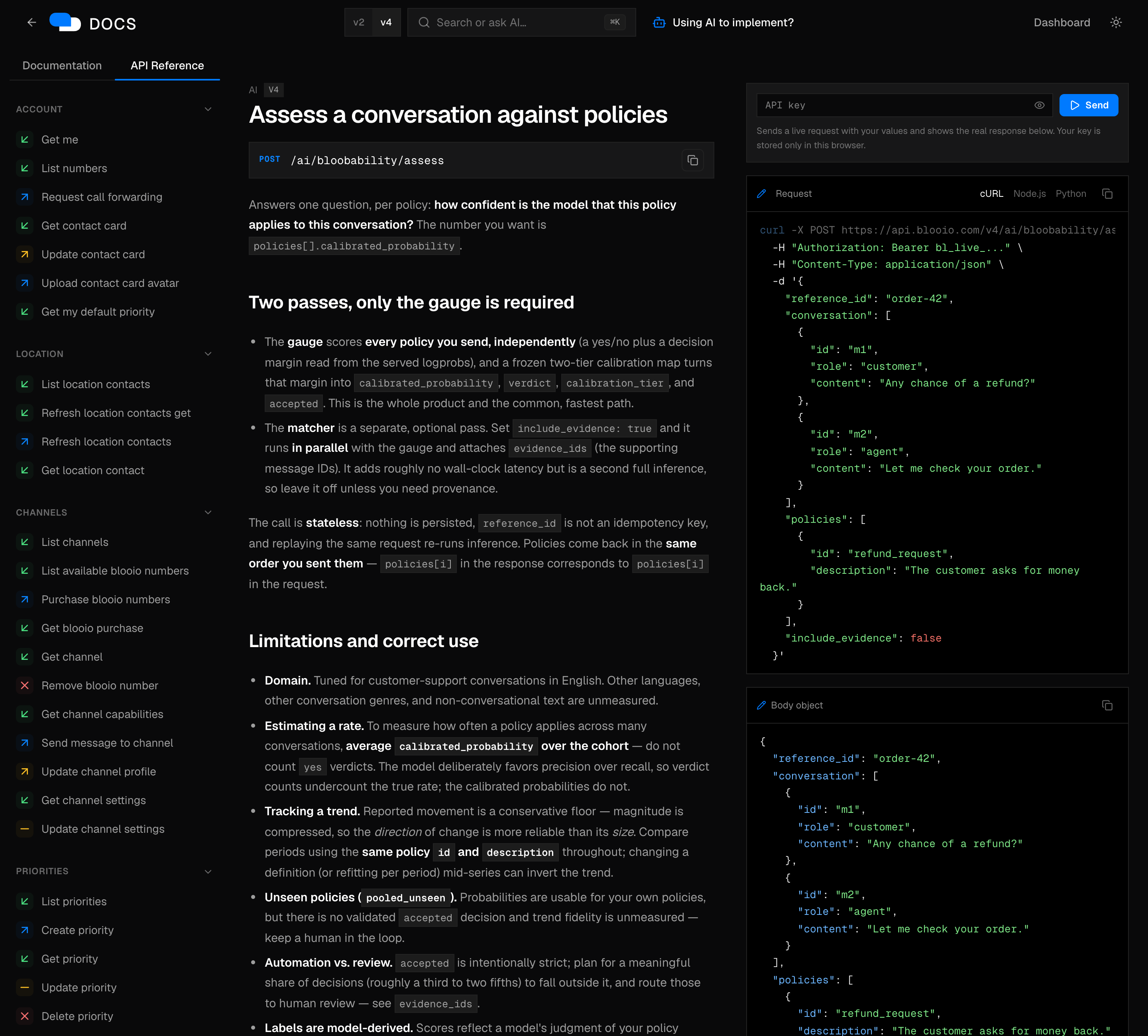
Everything the playground does is available over the API, authenticated with your Blooio key. Here's the same assessment as a copy-paste curl; the full schema, field-by-field notes, and a live "try it" console are in the assessBloobability API reference.
curl -X POST https://api.blooio.com/v4/ai/bloobability/assess \
  -H "Authorization: Bearer bl_live_..." \
  -H "Content-Type: application/json" \
  -d '{
    "reference_id": "ticket-8821",
    "conversation": [
      { "id": "m1", "role": "customer", "content": "Refund the $184 to my card today." }
    ],
    "policies": [
      { "id": "refund_request", "description": "the customer asks for money back" }
    ]
  }'
Your Policies vs the Built-In Roster
Blooio ships with about 80 common items already set up and fine-tuned — refund requests, agent greetings, pricing pushback, and more. If what you want to track matches one of these (reuse its roster id), you get a result that's been specially tuned for it, including that strict accepted decision you can safely automate on.
Anything else you want to track still works — a novel policy is scored a bit more generally on the pooled map (pooled_unseen), so you still get a real, reliable probability rather than a rough guess. You just won't get the per-label accepted flag until that policy has been calibrated.
Where Bloobability Fits in Your Workflow
This isn't meant to replace people reading conversations. When a thread is genuinely unclear, Bloobability says so instead of guessing, and flags it for a human to review.
In practice, clear cases get tagged and handled automatically while the tricky ones go to your team. Over time that saves hours — not because everything is automated, but because your team only reviews the conversations that truly need a human touch.
What This Means for You
If you're already sending customer conversations through Blooio, you don't need to change anything. Bloobability works with what you already have and lets you see what's happening — without hiring someone to read every thread or waiting until a customer leaves to spot a problem. It pairs naturally with a solid customer follow-up strategy over text.
For most businesses that means catching problems sooner: a rise in billing complaints, a marketing message that isn't working, or a support script that keeps getting pushback. It also means your reports — to your team or your clients — are grounded in what customers are actually saying, not just how many texts were sent or received. If you're building automated replies on top of this, see how to build an iMessage AI bot and which channel to send on.
Frequently asked questions
- What is conversation intelligence?
- Conversation intelligence is software that reads customer conversations and turns them into structured signals — sentiment, intent, and topic trends. Bloobability is Blooio's version, tuned to text and chat threads and driven by policies you write in plain English.
- Can I try Bloobability without writing code?
- Yes. The Bloobability playground at blooio.com/inference/bloobability/playground scores a message live against built-in tone, intent, and evidence policies, and lets you add your own policy in a sentence. No account or code required.
- How do I call it from my own app?
- Send a POST to /ai/bloobability/assess with your conversation and policies. The full schema and a live console are in the API reference at docs.blooio.com/reference/v4/ai/assessBloobability.
- What is the difference between roster and pooled_unseen?
- The policy id is the calibration key. Reusing a built-in roster id gives you a specially tuned result plus a strict accepted decision. A novel id you invent is scored on the pooled map (pooled_unseen) — still a usable probability, but with no validated accept flag.
- Does Bloobability do sentiment analysis?
- Yes, and more. Sentiment (happy, frustrated, at-risk) is one kind of policy, but you can also track concrete events like refund requests, cancellations, billing disputes, or pricing pushback — anything you can describe in a sentence.
See what your conversations are really saying
Score a live message in the playground, then wire the assess API into your own stack. If you already message through Blooio, Bloobability works on what you have.
Open the Bloobability playground