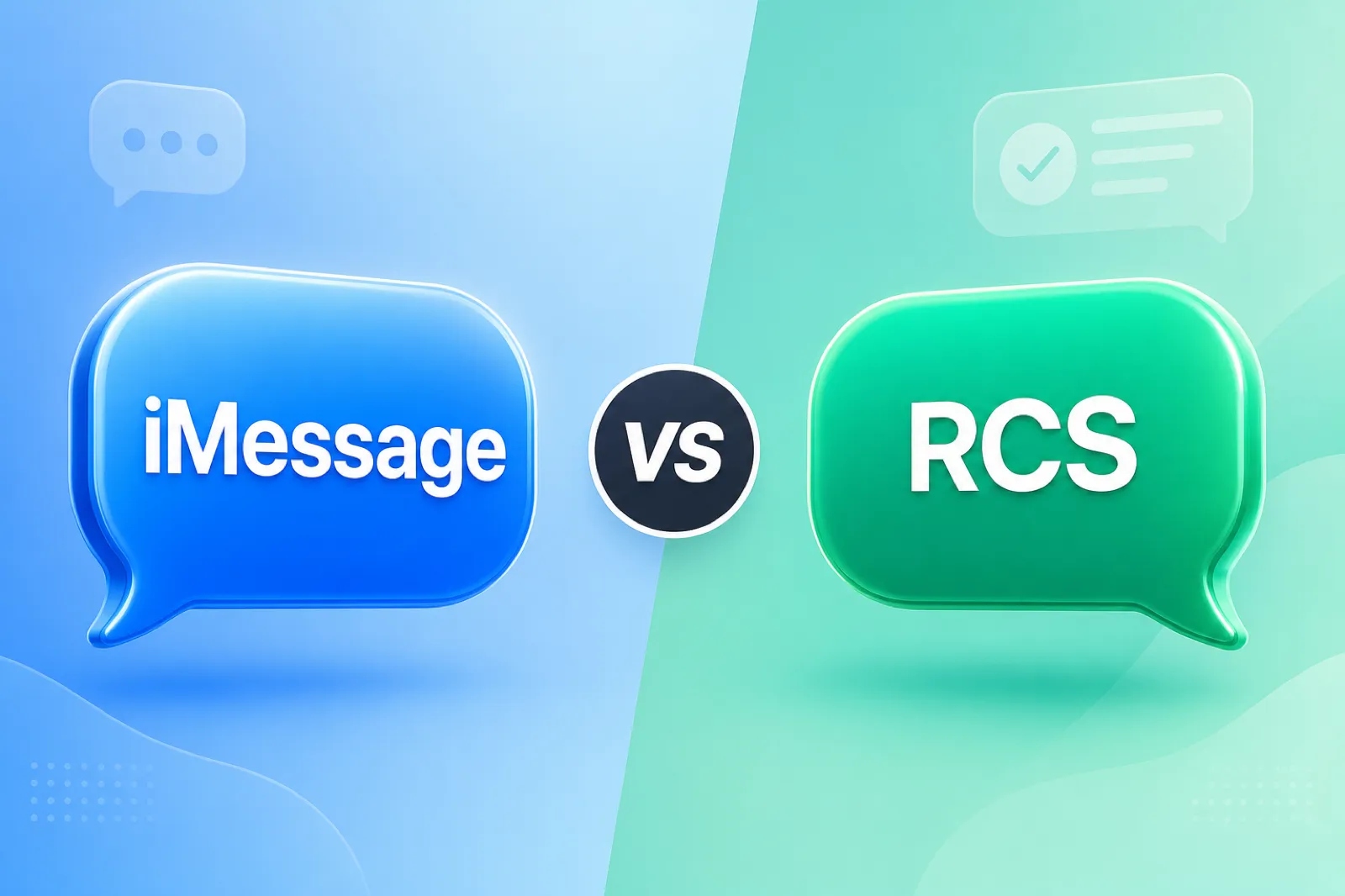
iMessage vs RCS in 2026: open rates, deliverability, cost, and reach compared. See which channel actually wins for business messaging — and how to use both with automatic fallback.

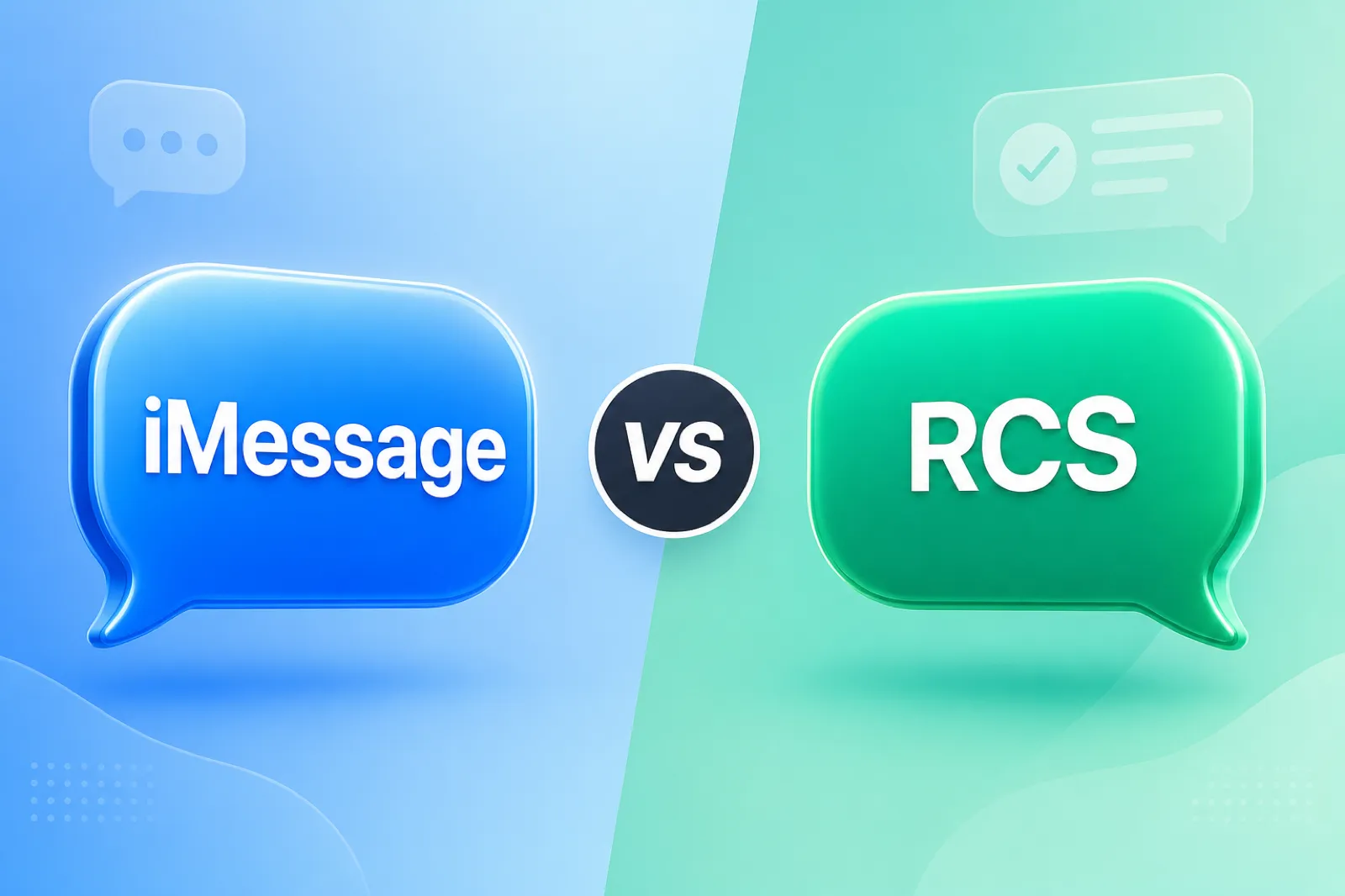
This guide breaks down both channels the way a growth or ops team should think about them — by reach, engagement, deliverability, trust, and cost — and then shows the part most comparison posts skip: how to send on the channel your customer is actually on, with automatic fallback so nothing bounces.
iMessage is Apple's encrypted messaging service — the blue bubbles built into every iPhone, iPad, and Mac. With iPhone holding roughly 57-60% of the US smartphone market, iMessage is the default messaging experience for the majority of American consumers. Messages arrive natively, unfiltered, and inside the thread people already check dozens of times a day.
That's why iMessage posts the highest engagement numbers of any messaging channel: open rates around 98% and response rates of 30-45% for well-crafted outbound. The blue bubble itself is a trust signal — it tells the recipient the message came through Apple's network, not a carrier spam route.
The catch you'll read everywhere: "iMessage has no business API." Apple's official Messages for Business is permission-based and user-initiated, so by the book you can't upload a list and send a campaign. We'll come back to why that's only half the story.
RCS (Rich Communication Services) is the modern successor to SMS. It adds read receipts, typing indicators, high-resolution media, branded sender profiles, and interactive buttons — all inside the phone's native Messages app, no extra download required. It's been native on Android since 2019, and Apple added support in iOS 18, which is what finally made it relevant at scale.
For businesses, RCS (via Google's RCS Business Messaging) means a verified brand profile — your logo, name, and a trust badge — plus the ability to message customers first. Read rates land around 72-92% and response rates around 15-25%: a clear step up from SMS, though still below iMessage. The trade-offs: RCS needs a data connection, isn't supported on every carrier or older device, and A2P RCS requires Google verification.

Here's how the three channels stack up on the metrics that actually move revenue. Treat the figures as widely-cited 2026 industry ranges, not guarantees — your numbers depend on list quality and offer.
Almost every iMessage vs RCS article concludes the same way: "iMessage is great, but you can't use it for outbound business messaging, so use RCS." That conclusion is convenient for RCS vendors — and it's outdated.
Blooio gives you a real iMessage API: dedicated lines that send genuine blue-bubble iMessages, with real-time webhooks for replies, so you can run two-way conversations, support, bookings, and outreach to your Apple-using customers programmatically. No Mac to babysit, no green-bubble downgrade. See the iMessage API and the iMessage for business guide for the full setup.
That reframes the whole debate. It's not "iMessage can't, so RCS." It's: reach your iPhone customers on iMessage where engagement is highest, and reach everyone else on RCS or SMS.
Cost is where the channels diverge in a way the open-rate tables hide. RCS and SMS are priced per message (and SMS per segment), and A2P 10DLC adds registration fees and carrier pass-through charges. RCS sits roughly between SMS and richer channels on a per-message basis, with better engagement per dollar than plain SMS.
iMessage is typically priced per line/seat rather than per segment, which changes the math entirely for two-way and high-frequency conversations: once you've got the line, the marginal cost of another message in a thread is effectively nothing. For high-engagement use cases — support, sales follow-up, bookings — that per-line model usually wins on cost-per-conversation even though the headline price looks different.
The practical answer most teams land on: don't pay SMS rates to reach an iPhone user who'd happily reply on iMessage, and don't try to force RCS where iMessage already converts.
The honest verdict on iMessage vs RCS is that the question is slightly wrong. iMessage wins on engagement and trust; RCS wins on cross-platform reach; SMS wins on universal fallback. A messaging stack that routes each message to the best available channel — iMessage for Apple users, RCS or SMS for the rest — beats betting the whole strategy on one bubble color.
We broke down exactly how that routing plays out for cold outbound in Hybrid Mode: SMS cold outbound + iMessage replies that convert, and if you're automating the conversation itself, see how to build an iMessage AI bot.
Send real blue-bubble iMessages at scale with dedicated lines, two-way webhooks, and automatic SMS fallback.
Get started with Blooio
Cold SMS gets you reach; iMessage gets you replies. Hybrid mode sends cold outbound over A2P SMS, then automatically continues on a blue-bubble iMessage line the moment a lead replies — the scale of A2P with the conversation quality of P2P.

Plugging GPT-4o, Claude, or any LLM into iMessage gets a working bot in 50 lines of code. Shipping one that survives production — typing indicators, message splitting, conversation memory, idempotent webhooks, image handling — is a different story.

Most 2FA APIs bill you per verification and cap you out. Here's a flat-rate, no-hard-caps way to verify users at scale over iMessage — with a live demo you can try right now.