
API v4
The most highly rated iMessage API for business
Send, receive, verify, and automate iMessage through one REST API — with webhooks, delivery events, SDKs, and RCS/SMS fallback routing. Flat $39/mo, unlimited messages, free trial — no credit card.
Why Blooio API exists
The iMessage API for business messaging
The Blooio API is a REST interface for communicating across any channel programmatically — complete with fully-featured dedicated iMessage-enabled phone numbers, webhooks for real-time events, and delivery tracking, all behind a simple HTTPS endpoint.
iMessage REST API
Standard HTTP verbs over JSON. Authenticate with a Bearer API key and start sending to any phone number or email in seconds.
Apple iMessage API
Blooio runs real Apple infrastructure so your messages are delivered as blue bubbles, not SMS green bubbles.
Send iMessage from the API
One POST request sends an iMessage with text, attachments, reactions, or a multipart bubble — no SDK install required.
iMessage business API
This REST API sends from a phone number. Apple Messages for Business is a separate channel, and Blooio is an official Messaging Service Provider for it.
ONE API
One API. Endless conversation surfaces.
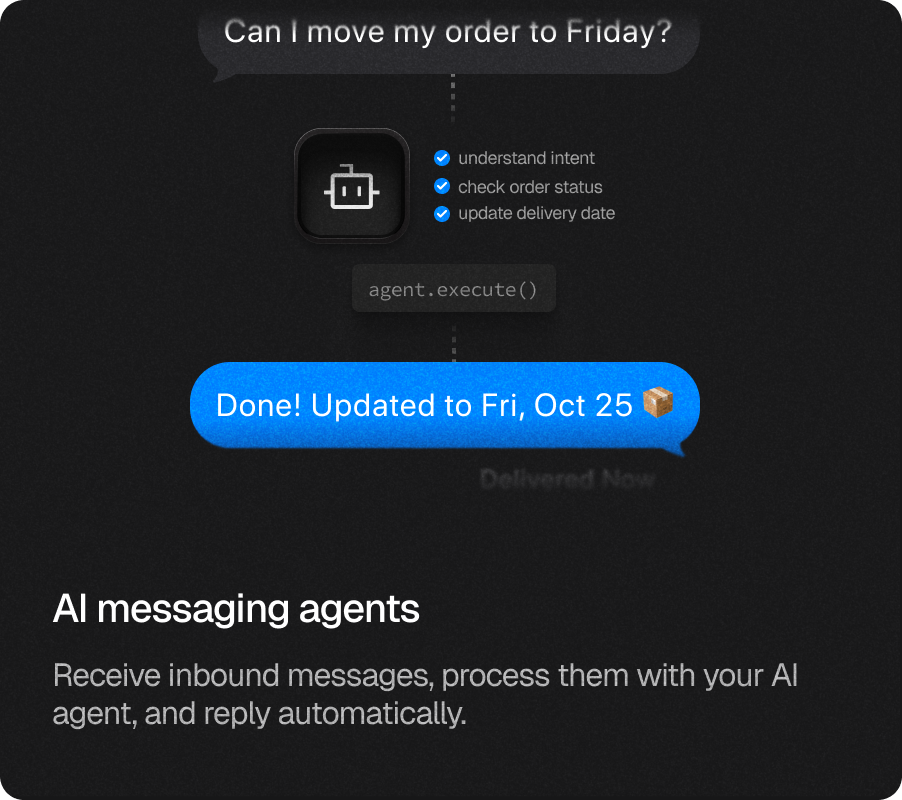
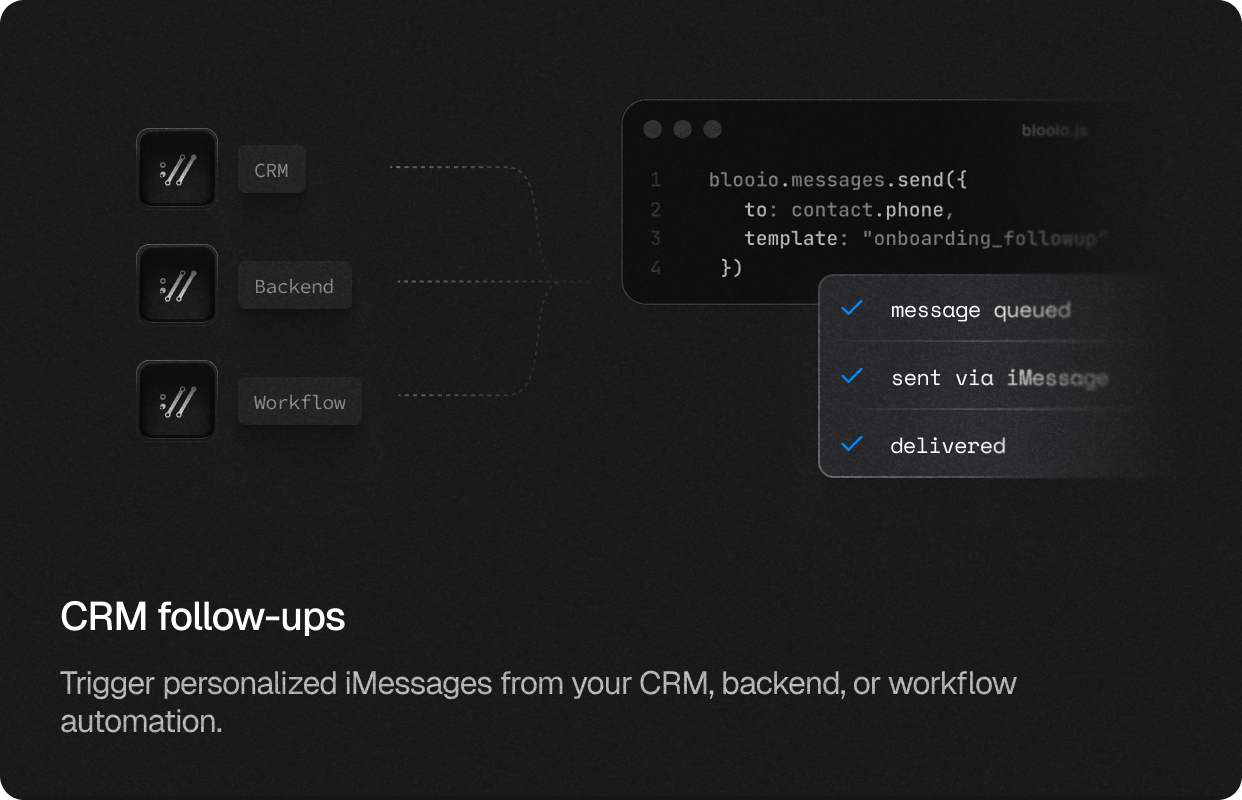
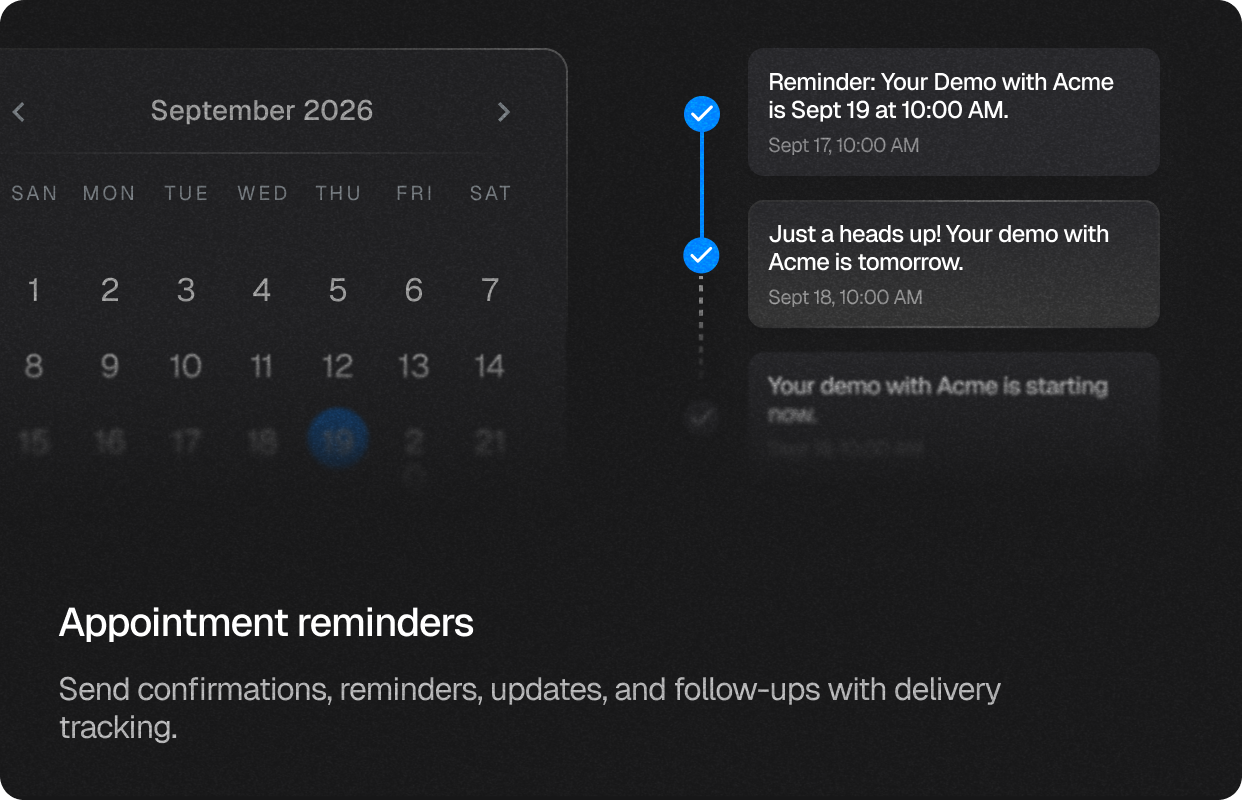
From AI agents to CRM automations — Blooio powers the messaging layer of your product.
Enterprise-ready infrastructure
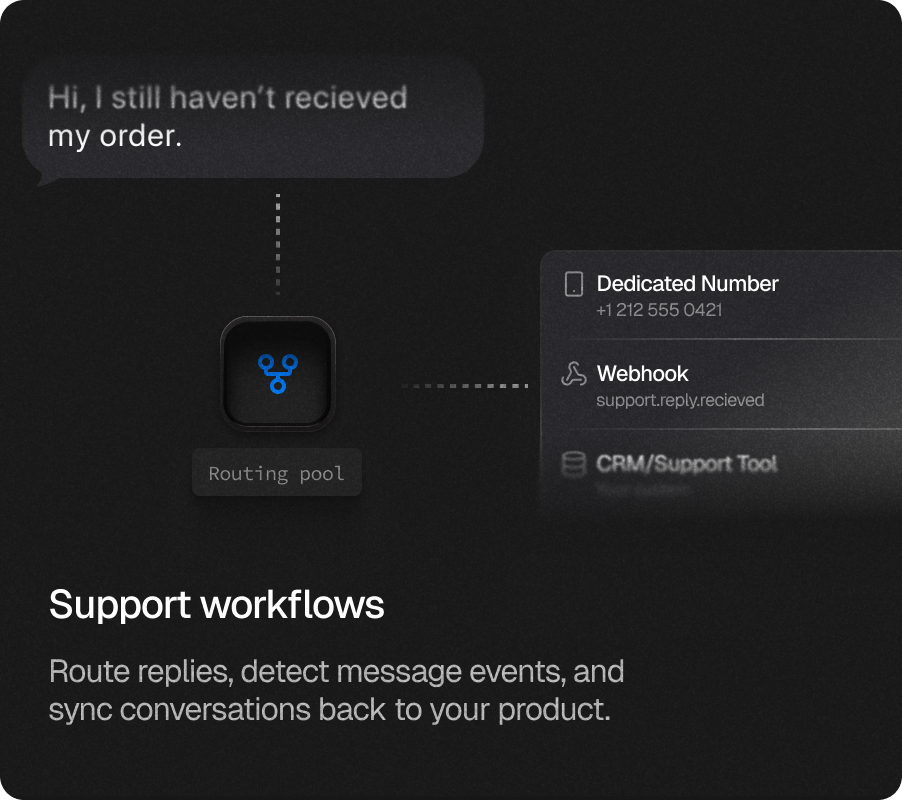
Support workflows
Route replies, detect message events, and sync conversations back to your product.
- OpenAPI 3.1
- Protocol Information
- Signature verification
Real-time Events
Webhook notifications for message delivery, read receipts, and reactions.
- Instant delivery
- Retry logic
- Event filtering
Security First
End-to-end encryption with OAuth 2.0 and API key authentication.
- TLS 1.3
- HMAC signatures
- Rate limiting
200M+
monthly api calls
100K+
daily messages
99.9%
Uptime SLASLA guarantees subject to signed enterprise agreements
24/7
Support
what you can do
Explore the API capabilities
Browse the main endpoints for messages, contacts, webhooks, numbers, and more.


Every conversation
can trigger your app
Listen for replies, delivery updates, failures, reactions, and fallback events through signed webhooks.



Languages
Quick Start
Get started in seconds with your favorite language
cURL
1# Send a message to a phone number
2curl -X POST https://api.blooio.com/v4/messages \
3  -H "Authorization: Bearer YOUR_API_KEY" \
4  -H "Content-Type: application/json" \
5  -d '{
6    "to": "+1234567890",
7    "text": "Hello from Blooio! 👋"
8  }'
Response
1{
2  "id": "msg_019...",
3  "chat_id": "chat_019...",
4  "from": "+15551230001",
5  "channel_id": "ch_019...",
6  "channel_type": "blooio",
7  "status": "queued",
8  "routing": { "mode": "priority", "channel_type": "blooio" }
9}iMessage SDKs
Use REST directly or ship faster with SDKs
Frequently Asked Questions
Questions? Check the docs or reach out anytime.
What is the iMessage API?
The iMessage API on this page is a REST interface for sending and receiving iMessages from a phone number. Blooio is also an official Apple Messages for Business Messaging Service Provider; that channel is separate and lives at blooio.com/integrations/apple-messages-for-business. This REST API includes a dedicated iMessage-enabled phone number, webhooks, and delivery tracking.
Does iMessage have an API?
Yes. Blooio is an official Apple Messages for Business Messaging Service Provider, and this page is a separate phone-number REST API for sending and receiving iMessages, with webhooks, delivery tracking, read receipts, and attachments.
Is Blooio an official Apple Messages for Business MSP?
Yes. Blooio is an official Apple Messages for Business Messaging Service Provider (MSP). Apple Messages for Business is Apple's verified brand channel: customers message the brand profile, not a phone number, and Blooio connects the brand to that channel. This page is a different product, the phone-number iMessage REST API. See the Apple Messages for Business API.
Is there an official Apple iMessage API?
Yes for Apple Messages for Business: Blooio is an official Messaging Service Provider, and brands connect through Blooio. This page is a separate phone-number REST API. Apple does not publish a public API for sending iMessage from a phone number; Blooio provides that API here, with a dedicated number, webhooks, and SDKs. See the Apple Messages for Business API.
How do I send iMessages programmatically?
With Blooio's API, you make a simple POST request to send an iMessage. Pass the recipient's phone number and your message text, and Blooio handles delivery through real Apple infrastructure.
What is the iMessage API pricing?
Blooio starts at $39/month for a dedicated iMessage-enabled number with unlimited messages. There are no per-message fees, no segment charges, and no hidden costs. A free trial is available with no credit card required.
Can I use iMessage for business messaging?
Yes. Blooio is purpose-built for business iMessage communication. Use it for sales outreach, appointment reminders, customer support, and AI agent workflows.
What happens if the recipient doesn't have iMessage?
Blooio automatically checks each contact's capabilities before sending. If iMessage isn't available, you can fall back to RCS (for Android) or SMS via integrated Twilio support — all through the same API endpoint.
Does the iMessage API support webhooks?
Yes. Blooio provides real-time webhooks for message delivery, read receipts, reactions, and incoming messages. Every subscription receives every event type, so you switch on the event type in your handler. You can also rotate signing secrets and replay failed deliveries.
Does Blooio provide an iMessage SDK for Node.js, Python, Go, or Java?
Yes. Blooio maintains official open-source SDKs for Node.js / TypeScript, Python, Go, and Java. Each SDK wraps the REST API with typed clients, automatic retries, and webhook helpers. Install via npm, pip, Go modules, or Maven/Gradle.
Is Twilio's iMessage API the same as Blooio?
Twilio does not operate a public iMessage API. Blooio is a purpose-built iMessage REST API with dedicated iMessage-enabled phone numbers, webhooks, SDKs, FaceTime and FindMy endpoints, polls, and link-preview control — none of which are available through Twilio.
What is the best iMessage API in 2026?
The best iMessage API in 2026 is the one that ships unlimited iMessages on a flat plan, supports RCS auto-fallback, and exposes the full iMessage feature set (reactions, polls, FaceTime, FindMy, link previews) via REST. Blooio scores on all four: $39/mo flat, RCS since launch, every advanced endpoint exposed, and SDKs for Node.js, Python, Go, and Java. Free trial — no credit card.
Can I use the iMessage API with AI agents, Cursor, Claude, or GPT?
Yes. Blooio's webhook system forwards every inbound iMessage to your endpoint, so you can pipe messages into OpenAI, Anthropic Claude, or any LLM and reply via a single API call. Many teams pair Blooio with n8n, Make, or Cursor agents to run an AI-powered iMessage agent in under an hour. Total cost for most setups is Blooio $39/mo plus your LLM provider's usage.
Is there an affordable iMessage API for developers?
Yes — Blooio is the most affordable iMessage API for developers in 2026. The $39/mo shared plan includes unlimited iMessages, a dedicated iMessage-enabled phone number, webhooks, SDKs for Node.js, Python, Go and Java, and every advanced feature (polls, FaceTime, FindMy, RCS fallback). There are no per-message charges and no usage tiers to climb.
How does the Blooio iMessage API compare to Sendblue, LoopMessage, and Linq?
Blooio is flat-rate with unlimited iMessages from $39/mo; Sendblue and LoopMessage are tiered with overage fees and Linq is invite-only enterprise. Blooio also covers polls, FaceTime, FindMy, custom link previews, and a native GoHighLevel integration that competitors don't ship. Detailed head-to-head pages: blooio.com/alternatives/sendblue, /alternatives/loopmessage, /alternatives/linq.
Can I send iMessages from a CRM like HubSpot, Salesforce, or GoHighLevel using the API?
Yes. For GoHighLevel, Blooio is in the GHL marketplace as a first-party iMessage channel — no Zapier bridge required. For HubSpot, Salesforce, Attio, and Pipedrive, use the REST API directly, an n8n/Make/Zapier flow, or one of the SDKs. Inbound iMessages route to your CRM via signed webhooks.
50% off
6 lines → $195/line
Simple, transparent pricing
Choose the plan that fits your volume and scale as you grow.
- Built for AI agents
- Real-time inbound webhooks
- Receive unlimited messages⁴
- Reply to anyone who messages you first
- Full API access
- Dedicated phone number
- Cannot initiate new conversations
Auto-scaling
Dedicated
Maximum scale with tiered pricing
Number of lines
Save more as you scale. Best value: 6+ lines → $195/line
- Inquire about FaceTime audio & video calling
- Number pools
- Auto-scaling (inquire to activate)
- Auto-unbanning (inquire to activate)
- Volume pricing discounts
- Dedicated account manager
- Priority incident response
- Migration onboarding support
- Multi-organization number discounts
- Built for AI agents
- Real-time inbound webhooks
- Receive unlimited messages⁴
- Reply to anyone who messages you first
- Full API access
- Dedicated phone number
- Cannot initiate new conversations
Auto-scaling
Dedicated
Maximum scale with tiered pricing
Number of lines
Save more as you scale. Best value: 6+ lines → $195/line
- Inquire about FaceTime audio & video calling
- Number pools
- Auto-scaling (inquire to activate)
- Auto-unbanning (inquire to activate)
- Volume pricing discounts
- Dedicated account manager
- Priority incident response
- Migration onboarding support
- Multi-organization number discounts
Concierge
Need a hands-on implementation? Let our team build it for you.
- Brand verification
- Sandbox testing
- Experience Review
Empower your team. Achieve more.
Apple Messages for Business launches after brand verification, testing, and Apple's Experience Review. Talk to us and we'll scope the journey.